Academics at Hanover:
As a geology student at Hanover, you will develop your scientific reasoning through discoveries in the classroom and in the field. Geology studies are supported by a wide range of hands-on experiences that make learning come to life.
WHAT CAN I DO WITH A CAREER IN GEOLOGY?
Geology as a discipline teaches students how to approach scientific problems with cross-disciplinary methods and innovative solutions. Broadly, geology degrees can lead to careers in industry, education, non-profit, and government institutions.

A more in-depth look to geoscience career diversity and opportunities can be found here.
With a constant need for energy, increasing need for earth materials and resources, and concerns over environmental impacts, geoscience careers are constantly growing and diversifying. As a result, the job market for geoscience majors is typically robust and in-demand.
At Hanover, geology students develop important scientific skills through coursework, lab experience, research experience, and fieldwork opportunities, preparing them for their career pathway of interest. Students also have the opportunity to study abroad at Hanover.
Hanover students have successful outcomes in the geo- and environmental sciences. Many of our students are employed immediately following graduation, while some continue their education in graduate programs.
Recent Outcomes – Student Placement
Some of our recent graduates have gone on to pursue advanced degrees in graduate programs around the country:
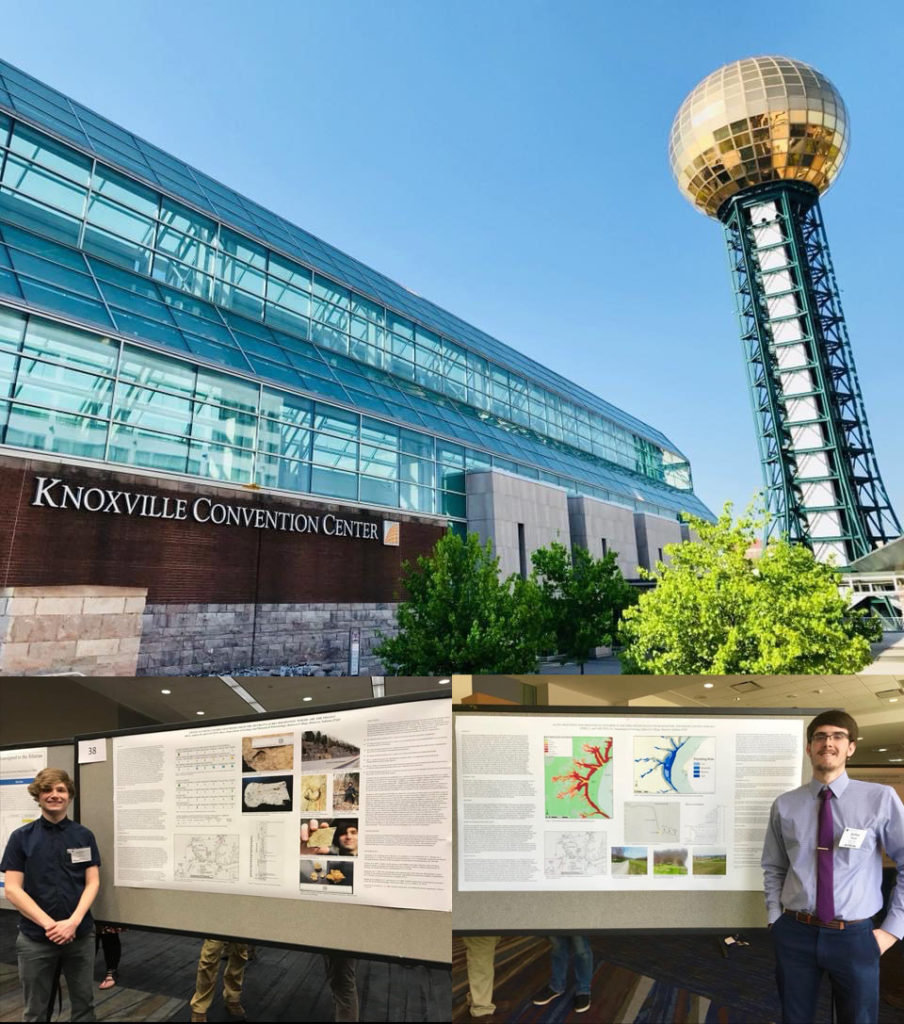
- PhD in History with a focus on environmental history at Indiana University, Bloomington, IN
- MPA in Public Affairs at Indiana University, Bloomington, IN
- MSES in Environmental Science at Indiana University, Bloomington, IN
- Juris Doctor with Dual Master of Arts, Bard Center for Environmental Policy, Annandale on Hudson, NY
- MS, Geophysics, Southern Illinois University, Carbondale, IL
- MS, Sedimentary Geology, Miami University Oxford, OH
- MS, Applied Geophysics, University of Pennsylvania Philadelphia, PA
- MS, Geology, Kansas State University Manhattan, KS
- MS, Geology, Delta State University Cleveland, MS
Many of our recent graduates are employed at a variety of positions in geology and related fields:
- Agricultural Resource Specialist Johnson City Soil & Water Conservation Dist., Franklin, IN
- Environmental Scientist, Aerotek Indianapolis, IN
- Environmental and Safety Oversight, Environmental Consulting, Inc. Stoughton, WI
- Environmental Specialist, Sanitation District I, Villa Hills, KY
- Field Chemist, Clean Harbors, Cincinnati, OH
- Geologist, Shelby Materials, Columbus, IN
- Geologist, Wilcox Environmental Engineering, Indianapolis, IN
- Geologist, Environmental Resources Management, Carmel, IN
- Geologist, Cardno ATC, Evansville, IN
- Hydrologist, IDEM, Indianapolis, IN
- Owner/CEO Travis Thompson Oil Corp., Mount Carmel, IL
- Project Inspector CTL Engineering, Indianapolis, IN
What Hanover Offers
The Geology Department at Hanover offers two different majors: Geology (BA or BS), and Environmental Science (BA). Students can also minor in these subjects.
The Environmental Science major offers four different trackways that allow you to specialize in areas of interest. Those trackways are: Environmental Geology, Environmental Biology, Geochemistry, and Geophysics. More details on the Environmental Science program can be found here.
Should a special interest arise, the geology department also offers independent study and directed study options.
Our majors are required to either complete an Internship (Environmental Science majors only), or a Senior Thesis (Geology and Environmental Science majors).
Interested in Geology?
Geologists study the natural world in an effort to understand how it works. There are many different subdisciplines and career pathways one can take in the geosciences. For more information on career fit, check out the Indiana Geology and Water Survey’s website.
If you’re considering a geology degree from Hanover College or just want to learn more about the program, please feel free to reach out to the geology faculty listed below via email.
Why is Geology Important?
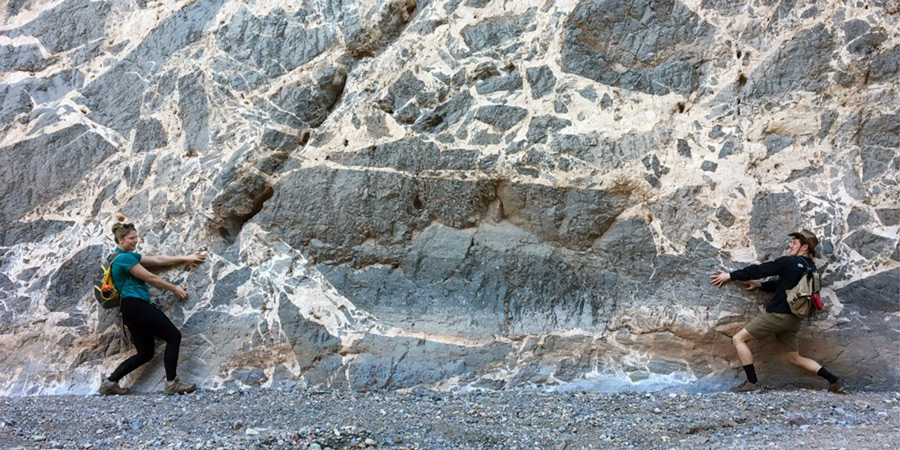
The geological and environmental sciences have a direct, daily impact on our lives – even if we don’t really think about it! The geosciences broadly encompass the hydrosphere, biosphere, lithosphere (rocks and Earth’s surface), and the atmosphere. This means that the materials we use (our air, water, minerals, rocks, and petroleum for starters), the things we manufacture (including plastics and electronics), many of the hazards we face (such as floods and earthquakes), and the impacts we have on the environment (excessive use of resources and pollution), fall under the span of the geosciences.
REAL-WORLD EXPERIENCES AT HANOVER
The geology department offers numerous exciting opportunities for studying geology in the field:
- Field-based courses
- Research opportunities
- Geology Club field trips
Field Courses
Our program emphasizes getting students into the field and examining geological features and processes where they occur. As such, all of our courses offer opportunities to observe the geology of our local setting through field labs, and we offer several 4-week field courses during the college’s May Semester:
- GEO 168 – Exploring the Geology of National Parks
This course travels to several National Parks in the American Southwest on a 3-week, camping and hiking excursion. Standing among America’s most distinctive landscapes (including Arches, Capitol Reef, Grand Canyon, and Zion National Parks), students will investigate the geological processes that formed them while being introduced to the fundamental skills of a geologist: identifying minerals and rocks, characterization of rock units, recognition of geologic structures, interpreting topographic and geologic maps, and more. Designed for those with limited outdoor or geological experience. - GEO 240 – Field Studies in Historical Geology
This course is taught at various field locations during May Term with an emphasis on reconstructing regional geologic and tectonic history. Students learn to identify and describe rock types, rock sequences, fossils, geologic structures, and surficial deposits and landforms; understand their formative processes; and place them within a given region’s developmental history. Students develop skills and experience using topographic maps, geologic maps, aerial photographs, and GPS for navigation and for recognition and mapping of geological features; with proper field descriptions and drawings; and synthesizing and interpretating geologic data. - GEO 337 – Geological Field Methods
This course is taught at various field locations in the American Southwest during Spring Term and emphasizes application of field-based geological methods, including mapping of rock units and structures, section measuring, GPS data collection and navigation, and wilderness safety. Additionally, field work addresses data collection and interpretation of stratigraphic relationships, depositional environments, and formation of geologic structures. It serves as the recommended culminating experience for geology and environmental science (geology, geochemistry, geophysics) majors and geology minors.
Research
Our faculty work side-by-side with students to provide those that are interested in building career and/or graduate school skills with opportunities to do collaborative research. Not only do students gain experience conducting research in a specialized discipline, but they also have the opportunity to share their research with other professionals at the national level. A list of presentations at conferences and/or publications in peer-reviewed journals involving Hanover students can be found under the individual faculty profiles.
Students at Hanover can get institutional support for summer research opportunities through the Geology Department’s own Totten Research Fund and through Science Division funding related to the Summer Research Program.
Recent student research projects include:
Cox, A., and Kumler, C. 2022 – GIS Applications in Geoscience Education, Examples from Grand Canyon Hiking Trail Maps Developed for the Website, Intheplaygroundofgiants.com
Neace, S. D. 2017 – Research on the Geology of the Grand Canyon region for the website, Intheplaygroundofgiants.com.
Rogers, K. 2017 – Revised mapping of the location and extent of late Pleistocene glaciation in the Central Oregon Cascades using LiDAR imagery.
Redmond, M. and Slover, H. 2016 – Research on the Geology of the Grand Canyon region for the website, Intheplaygroundofgiants.com.
Geology Club
The geology department partners with an active student-lead Geology Club to offer several field trips annually during the college’s Fall, Winter, and Spring breaks. These adventures provide great opportunities to learn geology in a conversational, inclusive setting. Recent travel destinations include:
- Death Valley National Park; 2019, 2022, and 2025
- Great Smoky Mountains National Park; 2019
- Zion National Park, Snow Canyon State Park, and Valley of Fire State Park; 2023
- Red River Gorge Geological Area; 2024
- Mammoth Cave National Park; 2026
- Saguaro National Park, 2027 (tentative)