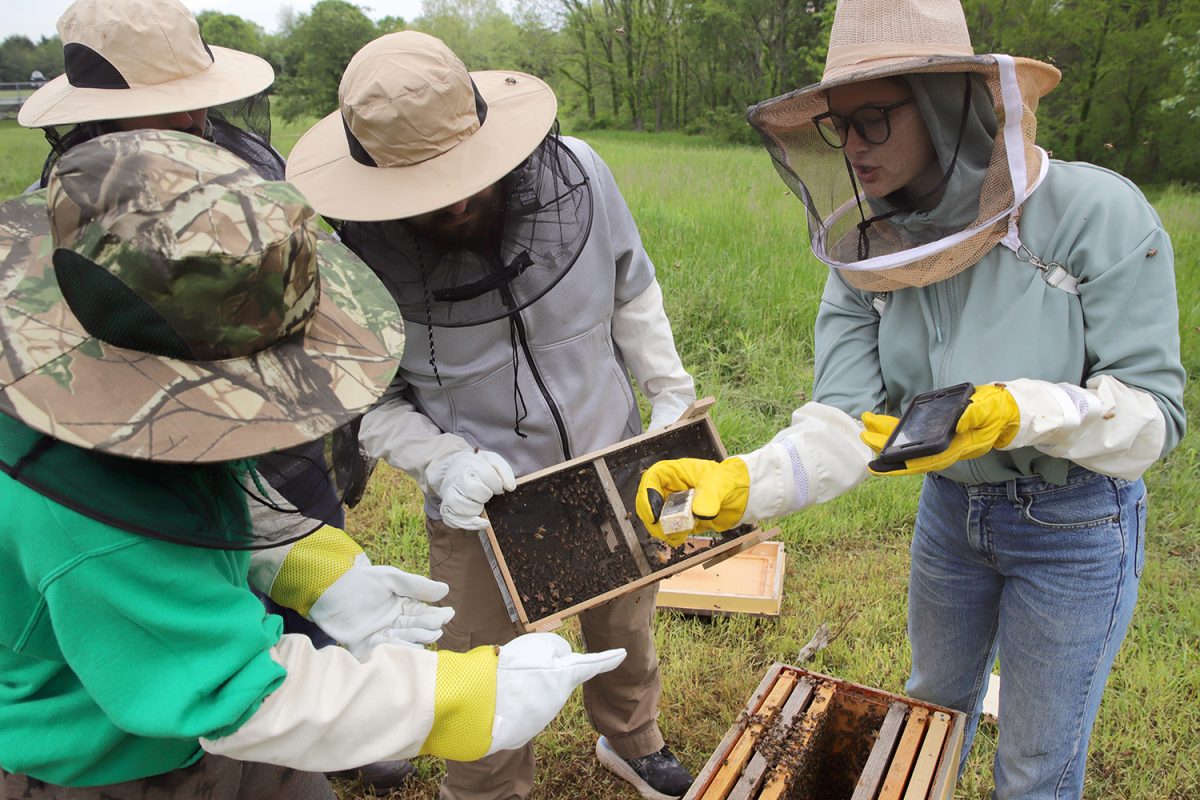
Academics at Hanover:
The Sustainability Studies major at Hanover College is an interdisciplinary program that examines the complex relationships between environmental health, social justice, and economic equity. Recognizing that sustainability challenges do not exist in isolation, the program explores the systems – ecological, social, political, and economic – that create and sustain these issues.
Through coursework that integrates perspectives from the natural sciences, social sciences, and humanities, students develop a deep understanding of how environmental and human systems interact. The major emphasizes critical thinking, collaboration, and problem-solving as students work to identify and evaluate solutions that support a healthy environment, advance social equity and promote a fair and resilient economy.
Why Study Sustainability at Hanover?
Hanover’s Sustainability Studies major prepares students to engage with some of the most pressing challenges of our time. Students learn to think holistically about global and local issues, grounding theory in real-world applications. The interdisciplinary nature of the program allows students to tailor their studies around their interests while gaining a strong foundation in sustainability principles.
Small classes, close faculty mentorship, and hands-on learning opportunities help students connect academic study with meaningful action – on campus, in the community and beyond.
Learn more about sustainability initiatives or the Social Justice Leadership Program at Hanover College.
Learning Opportunities
Students in the Sustainability Studies major may engage in:
- Interdisciplinary coursework spanning environmental science, economics, sociology, ethics and policy
- Community-based projects and experiential learning opportunities
- Research with faculty mentors
- Internships with nonprofits, government agencies and private organizations focused on sustainability and social impact
Careers and Graduate Study
Graduates of the Sustainability Studies program are well prepared for careers in environmental advocacy, public policy, nonprofit organizations, corporate sustainability, education, and community development. The major also provides a strong foundation for graduate study in sustainability-related fields, environmental law, public administration and beyond.
By combining knowledge across disciplines with a commitment to ethical and practical solutions, Hanover Sustainability Studies graduates are equipped to help build a livable planet for future generations.
COURSES
Major:
BIO 161 or BIO 165; ECO 224; ENV 265; GEO 236; SJ 161; one of MAT 217, PLS 239, PSY 217 or BIO 462; SUST457 or SUST471 (Culminating Experience), and four electives from at least two different disciplines from the electives list below. One of those electives must be a 300-level course, each of which has prerequisites listed in the sequences below. Total of 12-15 units.
Electives:
ARTD 224. Design Thinking and Problem Solving
BIO 225. Entomology
BIO 227. Herpetology
BIO 234. Plant Taxonomy
BIO 312. Conservation Biology
BIO 315. Ecology
ECO 221. Environmental Economics
ECO 337. Economic Development
GEO 221. Introduction to Geographic Information Science
GEO 334. Geomorphology
HIS 225. The History of the American Midwest
INS 161. Modern Africa
PLS 213. Introduction to Public Policy
PLS 321. Natural Resources Policy
PLS 359. Social Movements
SOC 217. Social Problems
SOC 231. Sociology of Food
SOC 235/THS 235. Confronting Addiction in Indiana
SOC236/THS 236. Social Justice in the Internet Age
SOC238. Society and Social Movements
SOC 338. Social Class and Inequality
SUST 260. Special Topics
SUST 360 Special Topics
SUST 370 Directed Study
THS 237. Religion, Ethics and the Earth
In addition to these courses, students are encouraged to petition SAAC with other courses, including Special Topics courses and semester abroad courses from international universities, that are substantially related to sustainability.
300-level sequences:
BIO 185, BIO 231, BIO 312 Conservation Biology
BIO 185, BIO 231, BIO 315 Ecology
ECO 113 or 114, ECO 337. Economic Development
GEO 16X, GEO 334 Geomorphology
PLS 1XX (except PLS 160), PLS 321 Natural Resources Policy
PLS 1XX (except PLS 160), PLS 359 Social Movements
Thesis and internship courses:
SUST 260 Special Topics
SUST 307 Directed Study – .50 units.
SUST 360 Special Topics
SUST 370 Directed Study
SUST 357 Internship – Off-campus supervised experience in Sustainability Studies.
SUST 471 Senior Thesis