Education
B.S. Miami University of Ohio
B.M. Miami University of Ohio
M.S. University of Wyoming
Ph.D. University of Chicago
Learn more about Dr. Laker
My research is focused on understanding the addition of information imparted to bones after death and how we can use that information to better understand the accumulation histories of fossil assemblages. I take two primary approaches to addressing this research: petrographic analysis of bones from marine stratigraphic sequences, and surface textural and chemical analysis of bones that have been weathering on modern terrestrial landscapes. My research uses both museum collections and field work collected materials.
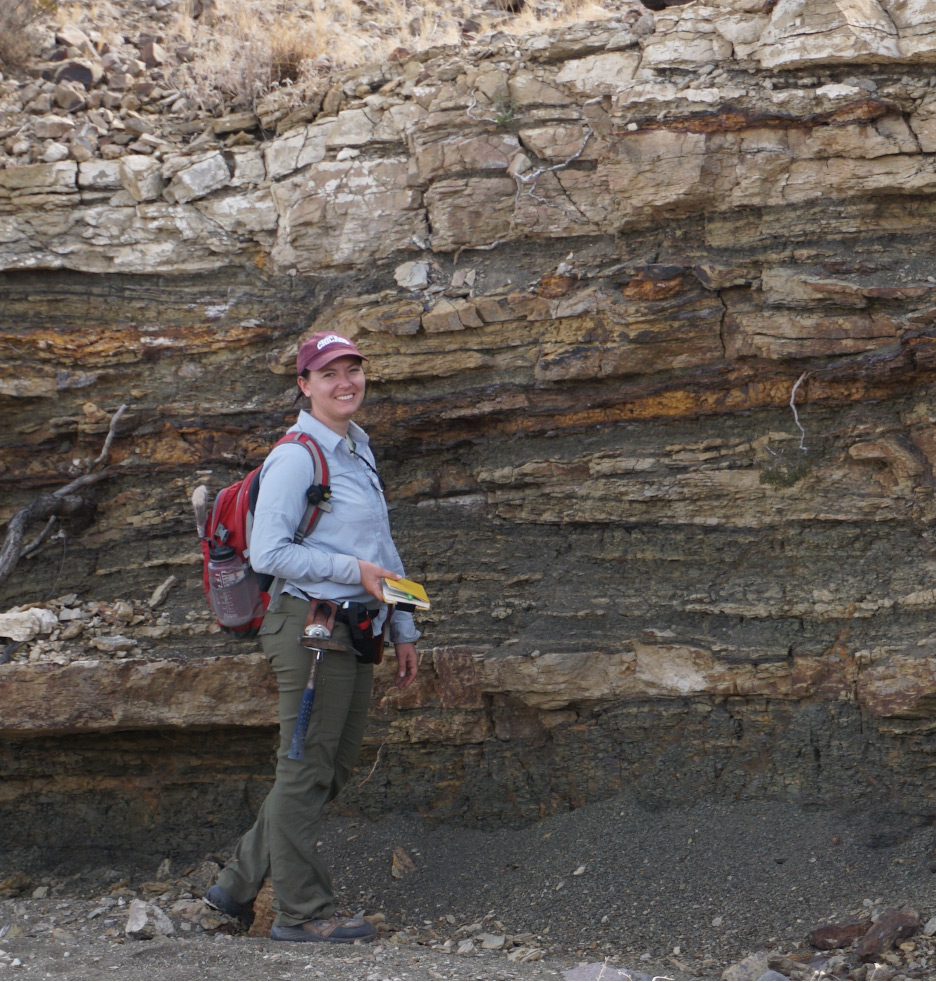
In the fossil record, I study fossil preservation as it relates to time, by exploring the relationship between exposure duration and bone preservation. Stratigraphic analysis—particularly marine siliciclastic sequences—offers the framework of time that permits me to test my hypothesis, because the relative rate of burial (or inferred exposure duration) can be estimated via sequence stratigraphic position. In marine records, I work in the Calvert Cliffs (Miocene, MD), Wadi Al-Hitan (Eocene, Egypt, collections only), and the Aguja Fm (Cretaceous, TX).
I further explore time in the modern/Pleistocene terrestrial realm, where skeletal material is more accessible, and accumulations are datable, to understand how additional factors such as environment and morphology promote or delay taphonomic destruction. To evaluate these factors, I examine cervid antlers from across the North American continent (southern Texas through northern Alaska) in collaboration with colleagues, to measure the rate of change in bone through quantitative methods and extensive radiocarbon dating.
My plans for future work include knitting these two systems together, by exploring terrestrial burial taphonomy in the recent and deep-time records.
Classes I Teach
GEO 167 Our Dynamic Planet
GEO 225 Mineralogy and Petrology
GEO 240 Field Studies in Historical Geology
GEO 263 Evolution and the Fossil Record
GEO 321 Sedimentology and Stratigraphy
GEO 337 Geological Field Methods
GEO 360 Geochemistry
Publications
[2] Laker, R.M., 2024. Vertebrate fossil permineralization in a sequence stratigraphic context: capsules of early diagenesis from shallow-marine siliciclastics (Eocene, Egypt). PALAIOS, v. 39, p. 243-263.
[1] Currano, E. D., Laker, R., Flynn, A. G., Fogt, K. K., Stradtman, H. and Wing, S. L., 2016. Consequences of elevated temperature and pCO2 on insect folivory at the ecosystem level: perspectives from the fossil record. Ecol Evol, 6: 4318–4331. doi:10.1002/ece3.2203
Selected Presentations
[19] Laker, R.M., Keenan, S., Miller, J.H., 2026. Assessing antler weathering rates across a latitudinal gradient. Indiana Academy of Science Annual Meeting.
[18] Miller, J., Franseth, R., Laker, R., 2025. Towards the quantification of bone weathering: new insights from 3D surface profilometry. Geological Society of America.
[17] Laker, R.M., Keenan, S., Miller, J.H., 2025. Antlers abound: assessing the rates of weathering across a latitudinal gradient. Geological Society of America.
[16] Laker, R.M., Franseth, R., Miller, J.H., 2024. Shed antler age-frequency distribution reflects caribou (Rangifer tarandus) calving ground trends recorded by wildlife monitoring in Ivvavik National Park, Yukon, Canada. Journal of Vertebrate Paleontology, Program and Abstracts, p. 320.
[15] Franseth, R., Laker, R.M., Miller, J.H., 2024. Quantifying bone weathering with surface texture modeling. Journal of Vertebrate Paleontology, Program and Abstracts, p. 200.
[14] Laker, R.M., Miller, J.H., Franseth, R., 2024. Evaluating long-term calving ground variability of caribou (Rangifer tarandus) from Ivvavik National Park, Canada.12th North American Paleontological Convention.
[13] Laker, R.M., 2023. Taphonomic variation at multiple scales: trends of occurrence, macro- and microscopic condition vary predictably across facies and along surfaces of nondeposition and erosion. Journal of Vertebrate Paleontology, Program and Abstracts, p. 258