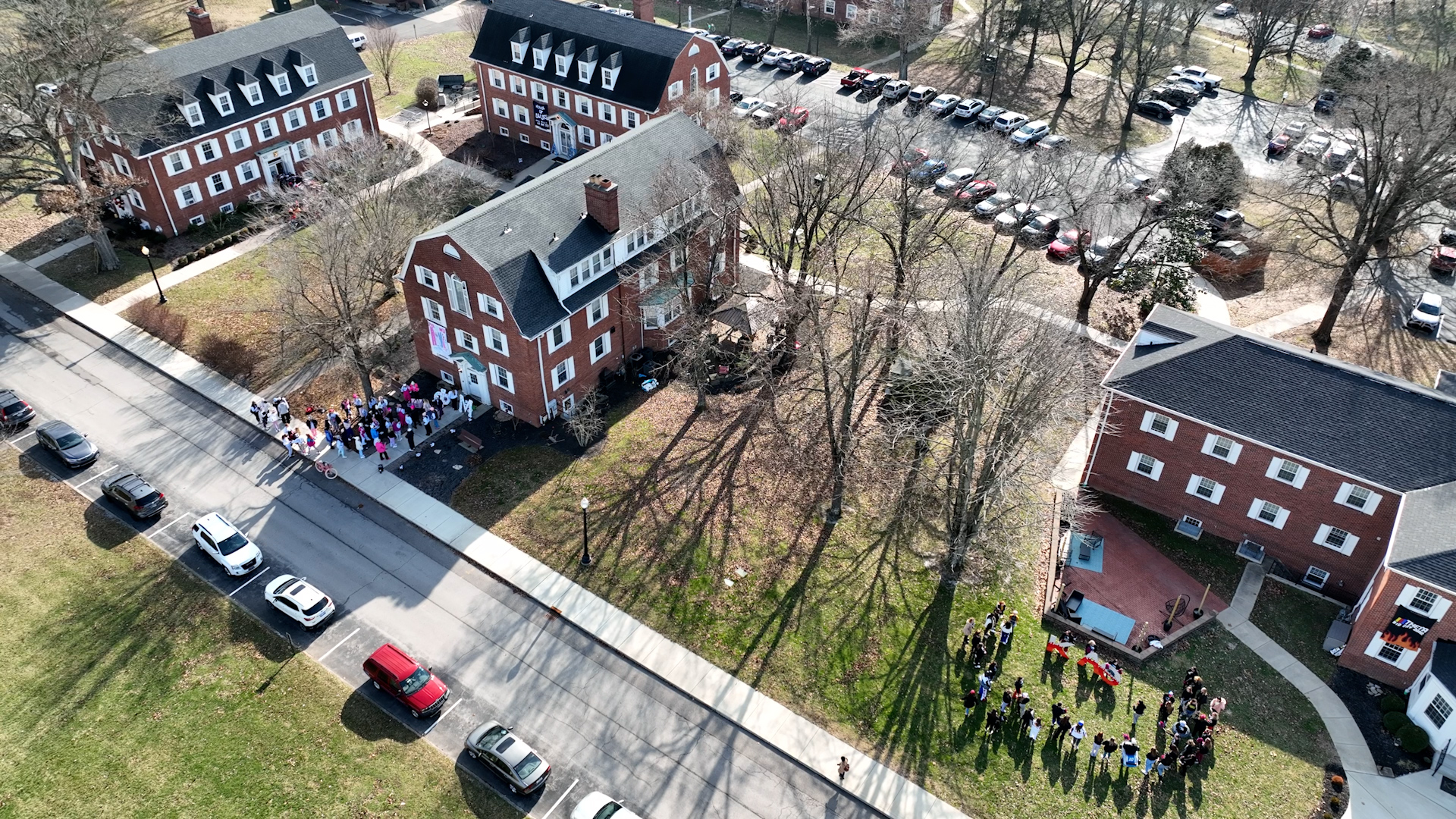
Hanover to review historical figures as it approaches its bicentennial.
As a nearly 200-yr old institution, Hanover College has a deep and rich history. Our ongoing commitment to being a welcoming community – as expressed in our “A Place to Belong” – makes it important for us to align our past, present and future. Consistent with academic institutions of similar age, this commitment includes reviewing the historical naming of buildings. It has always been our aim to provide our students with opportunities to seek academic, personal, and moral growth within a community that is safe, challenging, and responsive.
To deliver on our mission to embrace transformative learning and lifelong inquiry, as well as to acknowledge the College’s history, the Hanover College Board of Trustees has developed a process to review and evaluate the buildings, awards, and honors named after a small number of Hanover figures. With a focus on seizing the past as an opportunity to educate current and future students on the complicated legacies of a small number of Hanover figures, this process will preserve our mission while ensuring that our past is not forgotten.
“We realize that reviewing the historical names can be challenging for people for different reasons,” said Elaine Kops Bedel, Hanover College Board Chair. “The goal of the Board and Administration is to bring awareness, education, and context. The intent is to avoid cancellation and to promote understanding. As a liberal arts college, our charge is to educate students by providing a full telling of history and encouraging us all to engage in constructive dialogue.”
This process is ongoing and has and will continue to involve multiple campus stakeholders. The Board and Administration recognize that universal agreement on the outcomes and process will be challenging to achieve. We are committed to transparency and will share information about our progress and decisions in a timely manner.
Guiding Principles
The Board recently approved guiding principles to be followed during the review of historical naming. These include asking:
- Is the principal legacy of the namesake fundamentally at odds with the mission of the College?
- Was the relevant principal legacy significantly contested in the time and place in which the namesake lived and at the time of naming?
- Did the College, at the time of naming, honor a namesake for reasons that are/were fundamentally at odds with the mission of the College?
- What is the principal legacy of Hanover College?
- Do names on buildings/awards speak for the College; do they reflect “who” we are, and what do those names say on our behalf?
- What is the impact of the names on buildings/awards upon the students we are educating?
- What is the impact upon Faculty, Staff and Alumni?Does it matter that money was given for the naming?
- Is there a distinction between a naming for a public figure versus a private figure?
- Does the building or honor in question serve a substantial role in forming community today at the College?
Frequently Asked Questions
Why are we talking about guidelines for the review of historical naming of buildings?
As the result of information from the College’s archives and research from other historical sources, it was determined that the primary legacy of individuals for whom these buildings were named may stand opposed to the College’s mission and values based on espoused beliefs and/or actions taken in their lifetimes.
The Equity and Inclusion Committee is fulfilling its responsibility to “review and make recommendations regarding College acknowledgments of and responses to historical and current inequities in College policies, governance, and culture.”
Who has the authority to change and/or or adapt the current naming guidelines?
Only the Board of Trustees has the authority to change and/or adapt the current policies. No such recommendation or action has been presented to the Board.
Is the Board of Trustees planning on changing the name of any existing buildings?
The Equity and Inclusion Committee continues to work through its process for developing recommendations to the Board. It has not reached any conclusions nor made any final recommendations. The Committee acknowledges that there may be many possible recommendations, such as programs, speakers, historical markers and displays, or taking no action at all.
The Committee is looking at a range of options for recommendations to the Board, but at this time the Committee is focused on developing the best possible process for this complicated (and potentially contested) review. It completed a review of practices at other institutions of higher education, and it developed its own set of processes for recommendations to Board. In this review and development, the Committee sought and received input from constituency groups.
Does the Board have to accept a recommendation to change and/or remove a name?
No. The Board does not have to accept a recommendation to do so. The Committee may also make recommendations to the Board for actions such as historical markers and programs.
What names/buildings are under review?
John Finley Crowe, James Blythe, Thomas Hendricks and James Graham Brown.
The historical review of Hanover’s founder, John Finley Crowe, is complete. The Board of Trustees voted to provide education and contextualize regarding Crowe’s past.
How were the names selected for review; can additional names be added?
Referrals were made to the Trustees by the President.
Who is performing the research on the names for review?
The Committee asked President Lambert to determine the best way to provide research for review and discussion. Several members of the faculty and staff were approached to assist and it was determined that the College Archivist, Jen Duplaga, had the time and access to resources to best provide the research and supporting documentation.
Who is reviewing the names and can we participate?
Authority for naming is solely the responsibility of the Board of Trustees.
When will names be reviewed and decisions made?
The Committee has not established a timeframe for review and any potential recommendations. The Committee has focused on the process to ensure consistency, receipt of factual research and a thoughtful approach to understanding our history, its legacy and how to acknowledge and respond in a manner that supports the Hanover College Mission.
Have any decisions been reached?
Yes. The historical review of Hanover’s founder, John Finley Crowe, is complete. The Board of Trustees voted overwhelmingly to provide education and contextualize regarding Crowe’s past. The specific form of this education is a work in progress, but may include an explanatory plaque in Crowe Hall, integration of Crowe’s history into courses, and discussions around the Bicentennial in 2027.
How will we know the outcome of the committee’s work and recommendations?
Any recommendation made to and adopted by the Board of Trustees will be communicated to the Hanover College community.
How/why is this important to the College and the student experience?
We are a thoughtful community willing to learn from its past, courageously shaping a college that is equitable and inclusive.
If the person’s principal (truth) is deemed contrary to the College’s mission, what happens?
This will be the subject of our reflection and discussions; we have not determined any outcomes at this point in the process.
How will this further the College’s educational mission?
This effort proactively embodies our stated mission for “lifelong inquiry, transformative learning and meaningful service.”
How will students be impacted and/or learn from this?
We are modeling for students that complex issues are worth exploring, that sensitive dialogue can happen when all are committed to the healthy growth of the community, and that equity and inclusion are values we respect and actually promote.